9 Best Chicken Runs (October 2026)
The best chicken runs include the 9.8 x 6.5 Ft Covered Metal Run for compact covered access, the VEVOR 9.8 x 19.3 Ft Walk-In Run for a long covered enclosure, and the Betterhood Round-Top Metal Run for a broad round-top run.
On this page (7 sections)
- Best chicken runs for different yards
- How we compared these chicken runs
- What should you check before choosing a chicken run?
- Does a covered chicken run need extra weather planning?
- How much space does a walk-in chicken run need?
- Can a chicken run protect birds from predators?
- Which chicken run should you choose?
The best chicken run for a compact backyard is the 9.8 x 6.5 Ft Covered Metal Run, which combines walk-in access, a peaked roof cover and an included perch. For a larger flock area, compare the VEVOR and Betterhood long runs; for added ground coverage, consider Quictent.
A chicken run gives your flock outdoor space while keeping it contained. Match the footprint to your flock and yard, then check the mesh, door, roof and ground edge for the conditions where you live.
If you need a full setup, our backyard chicken coop guide explains how to pair a coop, run and door. Our best portable chicken coops page covers movable setups, and the best location for a chicken coop guide can help you choose a level, practical spot.
Our picks at a glance
-
1

-
2

-
3

Best chicken runs for different yards
The best chicken run depends on how much floor area you need, how you enter for daily care and what kind of cover or mesh the setup includes. These nine options are ordered by score, with compact and long footprints represented.
9.8 x 6.5 Ft Covered Metal Run: Best for compact covered access
- 9.8 x 6.5 x 6.5 ft
- Peaked detachable cover
- 47 x 40 in eucalyptus perch
- Reinforced frame supports
A compact walk-in footprint with a covered roof and perch gives a small flock a defined outdoor area. The 6.5 ft height allows access for feeding and cleaning.
Pros
- Walk-in height
- Cover helps shade and shed rain or snow
- Includes eucalyptus perch
Cons
- Shorter run length than the large enclosures
- Assembly time depends on experience and site conditions
The 9.8 x 6.5 Ft Covered Metal Run is the top pick for a smaller yard where you still want adult walk-in access. Its 6.5 ft height gives room to enter for feeding and cleaning, while the peaked roof cover helps shed rain and snow and adds shade.
A 47 x 40 in eucalyptus perch gives hens a raised resting place within the run. The frame has bottom corner braces and an additional rear support pole to help reduce wobble at the roof-to-base connection.
Allow about 2 hours for assembly, depending on experience and site conditions. Its footprint is much shorter than the large runs below, so measure the usable area before choosing it for a bigger flock.
VEVOR 9.8 x 19.3 Ft Walk-In Run: Best for a long covered enclosure
- About 19.6 x 9.8 x 6.5 ft
- Galvanized steel pipes
- PE-coated tarp
- Two-person installation
The long footprint suits buyers who need room to divide activity areas or give a flock more space to move. VEVOR recommends reinforcing the bottom against wildlife.
Pros
- Long walk-in footprint
- Covered roof
- Labeled parts and user manual
Cons
- Requires two people for installation and extension
- Extra bottom reinforcement is recommended
The VEVOR 9.8 x 19.3 Ft Walk-In Run suits a yard with room for a long enclosure. Its stated dimensions are about 19.6 x 9.8 x 6.5 ft, with galvanized steel pipes, hexagonal mesh and a PE-coated tarp for shade and rain protection.
Two people are needed for installation and extension. VEVOR also recommends reinforcing the bottom with galvanized wire fence, wood or stones to help address wildlife, so plan that work as part of setup.
This is a useful option when a short run would limit movement or separate activity zones. In a small yard, its length may make placement and access harder than the compact top pick.
Betterhood Round-Top Metal Run: Best for a broad round-top run
- 19 x 9 x 6.5 ft
- Triangular supports
- 240D Oxford cloth cover
- Coated hexagonal wire mesh
This broad enclosure combines a round-top frame with extra support columns and a covered roof. Its mesh sides allow ventilation while enclosing the run.
Pros
- Broad footprint
- Additional columns and triangular supports
- Covered roof
Cons
- No detailed assembly time is given
- Bottom predator protection needs its own plan
The Betterhood Round-Top Metal Run offers a broad 19 x 9 ft floor area and a 6.5 ft height. Its steel frame has additional support columns and triangular supports, while coated hexagonal mesh forms the sides.
A 240D Oxford cloth cover repels water, and the round-top design gives the enclosure a different profile from the peaked-roof options. The setup is described for chickens and several other animals, including ducks and rabbits.
Choose it when a broad run matters more than a compact footprint. Plan the base separately, since the product description does not specify a ground skirt or buried barrier.
Quictent Large Metal Run with Perch: Best for hardware cloth and ground skirt

- 1 x 1 in welded hardware cloth on side walls
- Extended mesh ground skirt
- Perch with natural wooden crossbars
- 750 zip ties included
The welded side mesh and extended ground skirt address two common enclosure planning concerns. A perch and optional side or back covers add useful setup choices.
Pros
- Welded hardware cloth on side walls
- Extended mesh ground skirt
- Perch and 750 zip ties included
Cons
- Optional side and back covers are not included
- Large footprint needs careful yard planning
The Quictent Large Metal Run with Perch is a strong fit if you want a ground skirt and welded side mesh included. Its side walls use 1 x 1 in, 20-gauge welded hardware cloth, and an extended mesh skirt is intended to thwart digging.
The run also comes with a perch with natural wooden crossbars and 750 zip ties. Optional side and back covers are available but are not included, so plan extra shelter if the roof alone does not suit your weather.
Its dimensions are about 17.9 x 8.9 x 6.5 ft, which requires a sizable clear area. The detailed manual and push-button frame are intended to simplify assembly, but allow enough space to lay out and secure the mesh.
Aoxun Spire-Roof Metal Run: Best for spire-roof runoff

- 10 x 20 x 6.4 ft
- 420D Oxford roof cover
- Lockable walk-in door
- Push-button connectors
The 10 x 20 ft footprint offers a long run with a spire roof and lockable entry. Aoxun recommends adding hardware cloth at the base for diggers.
Pros
- Long footprint
- Lockable walk-in door
- Push-button connector system
Cons
- Base reinforcement may be needed
- Weather protection claims do not replace local storm planning
The Aoxun Spire-Roof Metal Run gives you a 10 x 20 ft footprint with a lockable walk-in door. Its 420D Oxford fabric cover is described as waterproof and UV-resistant, and the spire roof is designed to shed rain and snow.
The frame uses 1 in diameter galvanized steel tubes with triangular supports. Aoxun recommends adding hardware cloth at the base for diggers, which makes the ground edge an important part of the installation plan.
This run makes sense when you want a long covered enclosure and can reinforce its base. Check the full dimensions against gates, paths and the coop entrance before ordering.
VAGGER 15 x 10 Ft Metal Run: Best for a medium-length walk-in run

- 15 x 10 x 6.5 ft
- Galvanized steel tubes
- Hexagonal wire mesh
- Waterproof UV-resistant roof cover
A 15 x 10 ft footprint sits between compact and extra-long runs. The peaked roof cover and full-height entry support everyday access.
Pros
- Walk-in height
- Peaked cover helps direct rainwater
- Full-height access door with latch
Cons
- Capacity depends on breed and setup
- No added base barrier is described
The VAGGER 15 x 10 Ft Metal Run sits between compact runs and the longest enclosures in this group. Its 6.5 ft walk-in height, full-height access door and peaked cover are geared toward regular feeding, cleaning and flock care.
The galvanized steel tubes form the frame, with hexagonal wire mesh around the enclosure. The fitted roof cover is described as waterproof and UV-resistant, and its peaked shape helps direct rainwater away.
Vagger gives a capacity estimate of 20 to 30 chickens, but says capacity can vary by breed and setup. Use the footprint and your flock’s needs to make the decision instead of relying on a headcount alone.
Benass 10 x 20 Ft Covered Run: Best for included run accessories

- About 19.7 x 9.8 x 6.56 ft
- Two roof covers
- Split door design
- Perch and PVC-coated wire
The accessory set includes two covers, a perch, a wire roll and fastening supplies. Its split door can make feeding access easier.
Pros
- Two roof covers
- Split upper and lower door sections
- Perch and fastening supplies included
Cons
- Large footprint needs clear yard space
- Check the door opening against your access needs
The Benass 10 x 20 Ft Covered Run includes two roof covers, a perch, a roll of PVC-coated chicken wire, bungee balls and zip ties. Its split door has upper and lower sections, which can make feeding access more convenient.
Its dimensions are about 19.7 x 9.8 x 6.56 ft, so it needs a generous stretch of yard. The two polyethylene covers provide roof coverage, and the metal frame includes reinforcement bars at the four corners.
Choose Benass if the accessory set matches the way you plan to build and use the enclosure. Check the door opening and mesh coverage for your coop layout before you start assembly.
Garvee Spire-Roof Metal Run: Best for a compact spire-roof enclosure

- 9.8 x 6.5 x 6.5 ft
- Triangular braces
- Waterproof cover
- PVC-coated hexagonal wire mesh
This compact footprint pairs a spire roof with triangular frame braces and a covered top. It suits buyers who want a smaller enclosure without a long run.
Pros
- Compact footprint
- Covered spire roof
- PVC-coated hexagonal mesh
Cons
- Less floor area than the long-run picks
- No perch is described
The Garvee Spire-Roof Metal Run is a compact alternative with a 9.8 x 6.5 ft footprint and a covered spire roof. Triangular braces support its steel frame, while PVC-coated hexagonal wire mesh encloses the sides.
The waterproof cover and roof shape are intended to help shed water, debris and light snow. Garvee also describes the run for ducks, rabbits, quail and other small animals, but check that the mesh and door suit the animals you keep.
Its footprint is similar to the top pick, though a perch is not described. Pick it when you want a compact covered enclosure and do not need an included resting perch.
HEYTOWN Dome-Roof Metal Run: Best for a compact dome roof
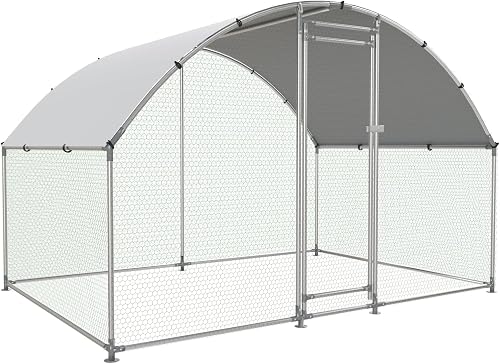
- 78 x 120 x 78 in
- Galvanized steel frame
- Plastic-coated hexagonal wire mesh
- PE cover
A dome roof and covered top suit buyers who prefer a compact enclosure with a curved profile. The run is described for chickens, ducks and rabbits.
Pros
- Covered dome roof
- Galvanized frame
- Plastic-coated mesh
Cons
- Shorter footprint than the large runs
- No perch or ground barrier is described
The HEYTOWN Dome-Roof Metal Run offers a compact 78 x 120 in footprint with a 78 in height. Its galvanized steel frame, plastic-coated hexagonal wire mesh and PE cover provide a simple covered enclosure for chickens, ducks or rabbits.
The dome roof gives it a curved profile, while the cover is described as waterproof and anti-UV. No perch or ground barrier is described, so consider how you will add resting space and protect the base for your yard.
This option fits buyers who prefer a compact dome design over a long walk-in run. Measure the planned location and door access carefully, especially if you need to move equipment into the enclosure.
How we compared these chicken runs
We compared the stated footprints, access height, roof covers, mesh details and included features against the needs of someone shopping for a chicken run. The score reflects how well those details fit the search, along with the flexibility each enclosure offers.
A larger footprint can be useful, but it only helps if it fits your yard and leaves access for care. For protection from digging animals, pay close attention to ground skirts or a separate barrier rather than assuming side mesh closes the bottom.
Covered roofs vary in shape and material, and they cannot guarantee protection in severe wind or snow. Follow the instructions for your chosen run and plan anchoring and seasonal care for local conditions.
What should you check before choosing a chicken run?
Measure the available ground area first, including clearance to open the door and walk around the enclosure. Compare that space with the run’s full dimensions, not only the area where chickens will stand.
Check how you will reach feeders, water and the coop entrance. A walk-in design can ease daily care, while a split door may offer a smaller opening for feeding.
Mesh and ground protection matter too. Look for clear details about mesh type and any skirt, then add a suitable base barrier if your local predators can dig under an enclosure.
Does a covered chicken run need extra weather planning?
Yes, a roof cover helps with shade and precipitation, but it does not replace a secure frame, sound anchoring or a plan for local severe weather. A peaked or spire roof can help water move off, while some manufacturers advise removing covers during extreme conditions.
Check whether the cover is detachable, how it fastens and whether side covers are included or optional. Keep the coop itself dry and ventilated, and inspect the run after strong winds or heavy snow.
How much space does a walk-in chicken run need?
A walk-in chicken run needs enough room for its footprint plus a clear approach to the door. The compact models here are about 9.8 x 6.5 ft, while several long runs are close to 20 x 10 ft.
Consider the number and size of your birds, the time they spend inside and the space taken by feeders or perches. For coop sizing, see our guide to choosing a chicken coop, then match the run to the coop entrance and daily routine.
Can a chicken run protect birds from predators?
A run can help contain chickens, but no mesh enclosure is automatically predator-proof in every yard. Inspect the mesh, door latch, corners and ground edge, and reinforce gaps based on the animals found in your area.
Quictent includes an extended mesh ground skirt, while VEVOR recommends adding a bottom barrier such as galvanized wire, wood or stones. For a full setup, our guide to keeping rats out of a chicken coop covers another common yard concern.
Which chicken run should you choose?
Choose the 9.8 x 6.5 Ft Covered Metal Run if you want a compact covered space with a perch and walk-in height. Pick the VEVOR or Betterhood for a broad, long footprint, and consider Quictent when a mesh ground skirt is a priority.
Before you decide, compare the run’s dimensions with your yard and coop, then plan the door approach and base barrier. For a movable setup, see our portable chicken coop guide.
Our top 3 picks at a glance
-
1
-
2
-
3
Frequently asked questions
How big should a chicken run be?
Choose a run that gives your flock room to move, with enough space for feeders, water and a dry resting area. The right footprint depends on flock size, breed, how much time birds spend in the run and whether they also get supervised outdoor time.
Measure the usable floor area after allowing for the coop and accessories.
Is a walk-in chicken run worth choosing?
A walk-in chicken run can make feeding, cleaning and collecting eggs easier because you can enter the enclosure. Check its door height and width against your own comfort and yard access.
For a small run, a lower design may fit a tight space, but routine care can mean more bending.
Does a chicken run need a roof?
A roof cover can provide shade and help keep some rain off the run. It does not replace a dry coop, strong anchoring or a plan for local wind and snow.
Check how the cover fastens and whether it can be removed for severe weather, then follow the product instructions for seasonal care.
How do I protect a chicken run from digging predators?
Use a barrier at ground level, such as hardware cloth secured around the base or an apron laid outward, and close gaps at gates and corners. VEVOR recommends adding galvanized wire fence, wood or stones at the bottom of its run.
Check local predator risks and inspect the barrier regularly for damage or soil movement.
Can one chicken run work for ducks or rabbits?
Some metal runs are also described for ducks, rabbits or other small animals, but the mesh openings, floor, door latch and roof cover must suit the animals you keep.
Plan separate shelter, bedding and feeding areas for each species, and check that no animal can squeeze through a gap.


