Do Chicken Coops Attract Mice?
Yes, chicken coops attract mice. Spilled feed, warm dry bedding and small gaps in the coop give mice food, shelter and an easy way in, so a coop with chickens almost always offers a mouse something worth staying for.
On this page (9 sections)
- Why do chicken coops attract mice?
- How can you tell mice from rats in a coop?
- Which parts of a chicken coop do mice use most?
- How do you stop mice getting into the feed?
- What coop repairs actually keep mice out?
- How do bedding and nesting boxes affect mice?
- Does an automatic door or a covered run help with mice?
- What should you never use against mice in a coop?
- How do you keep mice away for good?
Yes, chicken coops attract mice. Spilled feed, warm dry bedding and small gaps in the coop give mice food, shelter and an easy way in, so a coop with chickens almost always offers a mouse something worth staying for.
The chickens are not the main draw. The feed, the bedding and the warm shelter are.
Once you know which of those pulls mice in, keeping them out becomes a set of simple changes rather than a war on every mouse you see.
Why do chicken coops attract mice?
Mice come for food and stay for warmth and cover. A coop offers all three at once, which is why so many backyard flocks end up sharing their space with mice.
Feed is the biggest pull. Layers scatter pellets and mash, and a feeder left open at night is an easy meal.
Mice are also small enough to squeeze through gaps as narrow as a quarter inch, so most coops already have more entry points than the owner realizes.
Warmth matters too. A coop with deep bedding and chickens inside stays warmer than the open yard, and mice seek that out when temperatures drop.
The space under a raised coop floor and inside wall cavities gives them cover that predators can't easily reach.
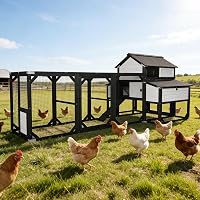
A wooden coop with rough sawn boards and a few loose panels is a particular favourite, because the gaps widen over the seasons and mice need only the smallest opening. The absorbent wood also holds feed dust and moisture, so the whole structure reads as food and shelter to a mouse scouting at dusk.
How can you tell mice from rats in a coop?
Droppings are the quickest clue. Mouse droppings are small, pointed and about the size of a grain of rice.
Rat droppings are larger, blunter and roughly the size of an olive pit.
Look for other signs as well. Mice leave a musky smell, small greasy rub marks along walls and shredded bedding or paper used for nests.
Rats are heavier and leave deeper tracks and larger burrows around the coop edge.
The difference matters because the fix changes. Rats need heavier mesh and deeper barriers than mice.
If the signs are large and the damage is serious, start with our guide to how to keep rats out of a chicken coop before moving on to the smaller fixes here.
Which parts of a chicken coop do mice use most?
Feeders, nesting boxes and the space under the floor are the three spots mice use most. Each one gives them something different.
Feeders and spilled feed around them are the food source. Nesting boxes hold soft bedding, and mice will line a nest in the corner of one if they can reach it.
The gap under a raised floor, or between the coop wall and its outer cladding, gives shelter close to both.
The Run-Chicken T50 fits here as a way to stop the nightly open-door problem. An automatic door closes the pop hole after the chickens go in, so the coop isn't left open to anything that wanders past after dark.
Its anti-pinch sensor holds the door when it meets an obstruction, so a hen caught in the opening isn't closed on.
How do you stop mice getting into the feed?
Store feed in metal or hard plastic containers with tight lids and clean up spills daily. Feed left in a bag in the coop is an open invitation, and mice will chew straight through paper or thin plastic.
Raise feeders off the floor and take them in at night if you can. A treadle feeder that the chickens open with their weight keeps mice and wild birds out while still feeding the flock.
Sweep up spilled pellets around the feeder and under the roost.
Don't leave scratch grain or kitchen scraps on the ground overnight. Feed the flock what they'll finish in a session, and store the rest in a sealed bin outside the coop rather than beside it.
A bin set a short walk from the run gives mice nothing to chew on right next to their shelter.
What coop repairs actually keep mice out?
Close the gaps and use hardware cloth, not chicken wire. Mice pass through chicken wire easily.
A half-inch hardware cloth over vents, gaps and low openings is the barrier that actually stops them.
Walk the coop with a flashlight and look for holes at the base of the walls, around the pop door and where the roof meets the walls. Patch small gaps with hardware cloth and seal larger ones with wood or metal.
Check the pop door closes fully, because a door left ajar at night is a wide-open entry.
Mice also climb. Look for gaps above the floor line and where the coop meets a tree or fence.
A coop on legs still needs mesh around the underside and a clear gap so mice can't use stored items as a ladder. Move feed sacks, tools and pallets away from the coop wall so they aren't a set of steps.
Which materials do mice chew through?
Mice chew through plastic sheeting, foam insulation, paper sacks and thin plastic bins with ease. They also gnaw at wooden edges over time to widen a gap.
Metal and hard plastic resist them.
Hardware cloth, sheet metal patches and metal feed bins are the materials that hold up. If you patch a gap with soft material, expect a mouse to be back at it within a season.
Check patches each time you clean the coop.
How do bedding and nesting boxes affect mice?
Deep bedding is warm and soft, which is exactly what mice want. Fine shavings and straw make easy nesting material, and a quiet corner of a nesting box can become a mouse nest.
Check nesting boxes regularly and replace soiled bedding. Look for shredded material, droppings or a hollowed-out dip in a corner that a hen didn't make.
A plastic nesting box is easier to empty and hose out than a wooden one with gaps and absorbent surfaces.
The Rockever plastic boxes give you a smooth, removable roof and a surface you can wipe clean, which makes it harder for mice to find a hidden corner to settle in. The HDPE shell has no wood grain to chew and no absorbent joints to hold smells.
Each box measures 40.1 by 20.8 by 20.3 inches and has a waterproof plastic roof, so the bedding inside stays dry and less appealing to a mouse looking for damp shelter.
Does an automatic door or a covered run help with mice?
An automatic door helps at night; a covered run helps by day. Neither one alone solves a mouse problem, but both cut down the open access that mice use.
An automatic door closes the pop hole after the chickens settle, so the coop is shut when mice are most active. That removes the easy walk-in route.
The T50 runs on a rechargeable battery rated for up to a year in cold weather and up to two years in warm climates, so the door keeps working through a winter without wiring. It uses light-sensor or timer mode in the app, so you can set closing time rather than rely on daylight alone.
It is rated from -15°F to 140°F and mounts with six screws.
A covered metal run keeps wild birds and rain out of the daytime space and gives the flock shelter without leaving feed exposed to the weather. The CHIKENCOOP 9.8 x 6.5 ft run is a walk-in size with a peaked roof and a detachable cover.
Its reinforced metal frame includes corner braces and a rear support pole, and the cover sheds rain and snow while shading the run. Assembly takes roughly two hours.
What should you never use against mice in a coop?
Never use rodent poison inside or near a chicken coop. Chickens and pets can eat bait or a poisoned mouse, and the risk isn't worth it.
Glue boards are also a poor choice around birds. They catch things you didn't intend to catch and are hard to deal with humanely.
Snap traps work if they're set in closed boxes the chickens and pets can't reach.
Physical exclusion, feed control and cleaning do most of the work. Traps in secure boxes handle the mice already inside.
Fix the entry points first, or you'll keep catching mice that walk straight back in. Set traps along the walls where mice run, not in the open middle of the floor, and check them daily.
How do you keep mice away for good?
Mice come back when the food and shelter come back. The lasting fix is to remove what draws them in and close what lets them in.
Keep feed sealed, sweep spills, and check the coop weekly for new gaps. Trim grass and clear stored items away from the coop walls so mice have no cover to approach under.
A snake can slip through the same gaps as a mouse, so read how to snake proof a chicken coop while you're already patching openings.
A tidy coop that's closed at night and sealed against small gaps gives mice far less to work with. If your flock is small and you're still choosing a coop, the best chicken coop for 4 chickens is a good place to start with one that's easier to keep sealed.
Flies follow the same food and moisture, so do chicken coops attract flies covers the next thing to check.
Yes, chicken coops attract mice, but they don't have to keep them. Seal the gaps, store the feed tight and close the coop at dusk, and you'll take away the food and shelter that make a coop worth moving into.
Frequently asked questions
Do chickens eat mice?
Sometimes. Chickens will peck at and kill small mice they corner, but they can't be relied on to control a mouse problem.
Treat chickens as a helpful accident, not a pest service, and still remove the food and shelter mice use.
Are mice dangerous to chickens?
Mice are mostly a nuisance and a disease risk. They contaminate feed and bedding with droppings and urine, and they carry parasites like mites and lice into the coop.
Healthy adult chickens are rarely harmed by mice, but chicks and eggs are more exposed.
Does a raised coop keep mice out?
A raised coop helps but doesn't stop mice. The floor is off the ground, so mice have less cover, but mice climb well and slip through the same gaps as on a ground-level coop.
Secure mesh and tight doors matter more than height.
Will poison work for mice in a chicken coop?
No. Rodent poison in a coop puts chickens and pets at real risk, and a poisoned mouse can be eaten by a chicken.
Use traps in closed boxes and physical exclusion instead, and keep bait and poison away from the birds.
What time of year are mice worst around coops?
Mice move indoors more in fall and winter as outdoor food and warmth thin out. Cold weather drives them toward the warm, sheltered space of a coop with bedding and a steady feed supply, so check gaps and feed storage before the first cold snap.