How to Secure a Chicken Coop
To secure a chicken coop, close every opening with half-inch hardware cloth, use predator-proof latches, and lock the pop door at night. Then bury or apron the run edges so digging animals can't get under the walls.
On this page (8 sections)
- How do you secure a chicken coop in the right order?
- Which wire actually keeps predators out?
- How do you predator-proof the pop door at night?
- How do you stop animals digging under the run?
- Should you lock the coop with a predator-proof latch?
- How do you keep feed and small pests out of a secure coop?
- Does a stronger coop structure make a difference?
- What is a simple daily and seasonal security routine?
To secure a chicken coop, close every opening with half-inch hardware cloth, use latches that animals can't undo, and shut the pop door after dark. Then protect the ground line so digging predators can't tunnel in.
Most break-ins come through the same weak spots: an open door at night, thin chicken wire, and gaps where the coop meets the ground. Fix those three and a coop turns from an easy meal into a hard target.
How do you secure a chicken coop in the right order?
Start at the ground and work up, because the weakest gap sets the standard for the whole coop. Walk the outside with a flashlight at dusk before you buy anything.
- Check the floor line and any gap wider than 1/2 inch.
- Look at wire type, staples and openings.
- Test every latch and hinge.
- Plan the night-time door routine last.
Do this audit twice a year, in spring and before winter. Damage and settling show up slowly, and a 1-inch gap you ignored in June is a rat highway by October.
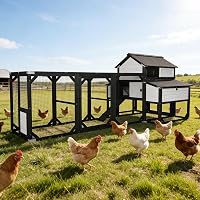
A raised wooden hen house sitting on legs has a floor line you can see, while a low coop hides rot and gaps behind the skirt. The ketive coop for 2 to 4 hens arrives with a reinforced wooden frame and L-shaped metal brackets, so the structure part is handled.
That leaves you free to spend your time on the wire, latch and door jobs where most coops fall short. Keep a short written list of what you find so you can work through it.
Which wire actually keeps predators out?
Use 1/2-inch hardware cloth, not chicken wire. Chicken wire keeps hens in, but a raccoon can pull it open and a fox can chew through light gauge.
- Hardware cloth is welded wire, and 1/2-inch openings block raccoon paws and small rodents.
- Chicken wire has thin, twisted strands and larger hexagons, so it's fine only as a secondary layer.
- Poultry staples every 2 inches hold the mesh tight against the frame.
Cover windows and vents too. A coop with open eaves or a mesh-free window is a door in raccoon terms.
The same rule applies to a chicken coop for 4 chickens, where small openings are often left as ventilation. Cut the hardware cloth a little larger than the opening and fold the cut edge inward so no sharp wire ends sit at bird height.
Then staple along every edge, not just the corners. Doors and lids are the spots people forget.
Add a strip of mesh or a tight-fitting board behind gaps at the nesting box lid or a rattling slide-out tray.
How much mesh does a small coop need?
Measure each opening, then add about 2 inches to every side for the fold and staple line. For the ketive coop at 62.2 inches long, count the run-facing sides, the vents and the nesting box lid.
Buy a roll with a little spare, since a second pass after winter damage is common.
How do you predator-proof the pop door at night?
Shut the pop door every evening, because most predators hunt after dark and an open doorway is the easiest way in. The honest question is whether you can be home at dusk every day.
An automatic door solves the timing problem. These are the two we'd look at for locking a coop down.
The JVR runs on 110V AC power (12V DC output) and takes a timer setting to the minute. Its screw-rod actuator holds the aluminum door shut like a deadbolt, and a pressure sensor reverses the door within 0.5 seconds if a hen is in the way.
The doorway opening is 11 inches wide and 12 inches high, and the unit needs a mounting space about 12 3/4 inches wide with height between roughly 30 and 42 inches. It works on wood, metal and plastic coops.
The Run-Chicken T50 runs on an included rechargeable battery, so no cable needs to reach the coop. It opens and closes on a timer or light sensor, with an app for settings, and mounts with six screws.
Run-Chicken says the battery lasts up to a year in cold weather and 2 years in warm climates. The unit measures about 13.8 by 9.4 by 1.3 inches and weighs around a pound.
Either way, test the door for a few days with the hens inside at dusk. A door that closes early or late defeats the purpose, and our review of the Aivituvin chicken coop covers how doors integrate with a full coop build.
What if the power goes out or the door jams?
Power loss is the classic failure point for a wired door. The JVR stores its timer settings and door position in a memory chip, so when power returns it resumes the same schedule without reprogramming.
It also has a manual override button that opens or closes the door in one press. The T50's rechargeable battery is the backup by design, so a house outage doesn't touch it.
On either door, keep a manual latch or a simple hook-and-eye beside the opening so you can lock the door by hand until you sort it.
How do you stop animals digging under the run?
Bury or apron the run edge, since foxes and rats dig under wire that stops at ground level. Two methods work best.
- Bury the mesh about 12 inches deep around the run perimeter.
- Bend an apron of mesh 12 to 18 inches outward at the base and stake it flat to the ground.
An apron is easier on existing runs because you don't dig a trench. Run the mesh down the wall and straight into the apron in one piece if you can.
A seam where the wall meets the buried strip is a weak point that a determined digger will find. Check the perimeter after heavy rain.
If your coop attaches to a separate run, the join between the two is another spot to reinforce. The ketive coop connects to a compatible wire mesh run sold separately, and that junction needs the same ground-line treatment as the rest of the fence.
Should you lock the coop with a predator-proof latch?
Yes, use a latch a paw can't flip or slide. Raccoons are strong and quick with their front paws, and they learn simple hooks fast.
| Latch type | Predator resistance | Notes |
|---|---|---|
| Simple hook | Low | A raccoon can lift it |
| Slide bolt | Medium | Add a carabiner or pin |
| Spring latch | High | Needs a push plus a lift |
| Padlock | High | Best for the main door |
Use a spring latch or a padlock on the main human door, and check the hinges too. Hinges on the outside are an easy target for a paw, so move them inside or cover them with a metal plate.
Tighten loose screws each time you do the seasonal walk.
How do you keep feed and small pests out of a secure coop?
Store feed in metal bins outside the coop and clean up spilled grain each evening. Rats and mice come for the food first, then attract larger predators.
Metal bins with tight lids beat plastic tubs, which rodents can chew. Clean the feeder each night rather than leaving a full one out, and patch small gaps with hardware cloth and wood.
A rat only needs a 1/2 inch gap, so look at the base of walls, around the pop door and where the roof meets the frame.
If your run is the open kind where animals can slip through, compare a chicken coop for 10 chickens to see how bigger coops handle the same weak spots. The ketive design uses raised perches and a built-in nesting box, so feed and water have a clear spot away from the roosting area.
Does a stronger coop structure make a difference?
Yes, a reinforced frame blocks the push and pry attacks, and L-shaped metal brackets are a sign of it. The ketive coop for 2 to 4 hens uses a reinforced wooden frame with L-shaped metal brackets, plus a waterproof asphalt roof.
The asphalt roof matters for security as much as weather. A flimsy roof that sags or leaks invites an animal to test the gap at the eave.
The ketive roof is heavy-duty asphalt that sheds rain, snow and UV, so it stays in shape. Cleaning matters to security too.
A pull-out manure tray and wide access doors make daily inspection easy, so small damage gets spotted before it becomes a hole. The hinged nesting box lid lets you collect eggs without propping a door open.
If you're still comparing options on the budget side, how much are chicken coops explains what changes with price.
What is a simple daily and seasonal security routine?
Check the door, the feed and the ground line every day, then do a deep check each season. Consistency matters more than any single gadget.
Daily:
- Close and latch the pop door after dark.
- Empty or cover the feeder.
- Glance at the run for fresh digging.
Seasonal:
- Walk the perimeter and re-staple loose mesh.
- Test the automatic door.
- Check hinges and latches for wear.
When you know how to secure a chicken coop, the job becomes a short evening habit. The best small upgrade for most flocks is an automatic door, and the Run-Chicken T50 is the pick here because it needs no wiring and runs on battery power.
If the coop has power nearby, the JVR adds a deadbolt feel with a timer you set to the minute. Lock the door, tighten the mesh and cover the ground line, and your hens sleep safely.
Our score weighs specs, features and what you're shopping for, based on published specifications and product listings.
Frequently asked questions
What is the best wire to secure a chicken coop?
Use 1/2-inch hardware cloth, not chicken wire. Chicken wire keeps hens in but raccoons and foxes can tear it or reach through it.
Fasten hardware cloth with poultry staples every 2 inches and cover it over the vents and windows.
Do I need to shut the coop door every night?
Yes, close the pop door after dark. Foxes, raccoons and opossums hunt at night, and an open doorway is the easiest way in.
An automatic door that closes on a timer takes the guesswork out of the job.
How do I stop predators digging under the run?
Bury the run mesh about 12 inches deep, or bend a 12 to 18 inch apron of mesh outward at ground level and stake it down. Either method stops animals from digging a tunnel into the run.
Check the edge regularly for fresh digging.
Can rats get into a secure coop?
Rats can squeeze through gaps as small as a 1/2 inch, so check where walls meet floors and around the pop door. Feed inside metal bins, store feed away from the coop, and fill small gaps with hardware cloth and wood.