How Long Should a Chicken Run Be?
A chicken run should be at least 10 square feet per bird, and longer is better than wider when space allows. As a rule of thumb, plan a length of about 4 to 5 feet for each square foot per bird you provide, so a 12-bird flock gets a run around 30 feet long.
On this page (9 sections)
- Why does the length of a chicken run matter more than its width?
- How many square feet does each chicken need?
- How long should a chicken run be for a small backyard flock?
- How long should a chicken run be for a bigger flock?
- How long should a chicken run be when the birds stay in all day?
- How do you calculate the run length for your own space?
- How wide should a chicken run be if you make it long?
- Does a long run change how you manage the flock?
- Which run length fits your flock?
A chicken run should be at least 10 square feet per bird, and longer is better than wider when space allows. As a rule of thumb, plan a length of about 4 to 5 feet for each square foot per bird you provide, so a 12-bird flock gets a run around 30 feet long.
Length matters because chickens walk. A flock with a long run has room to stride, peck along the fence line, and get away from a bossy hen without leaving the enclosure.
A short, wide run at the same total area gives less of that everyday movement.
Why does the length of a chicken run matter more than its width?
Length gives birds a straight path to walk and spread out, while width mostly gives them more area to share. Chickens move in lines along fences and hedges, so a long run lets them act like chickens instead of birds circling in a pen.
In a square run, every bird shares the same few feet near the middle. In a long run, a shy hen can walk to the far end and scratch quietly while the flock stays near the feeder.
That extra distance lowers friction between birds and cuts the chance of a bird being trapped in a corner.
Length also helps you. A long run lets you hang a feeder at one end and water at the other, so feed and water stay apart and the ground near each gets less wear.
You can also leave a resting patch at the far end while the near end recovers.
A chicken run that is long and not too wide is also cheaper to cover, because the roof spans the short side. You buy fewer long panels, and the cover stays low.
How many square feet does each chicken need?
Allow at least 10 square feet per bird in a run without free range. For a flock that stays in the run all day, double that to 20 square feet per bird.
Large breeds like Orpingtons and Brahmas do better with more than the minimum.
| Flock size | Run area at 10 sq ft per bird | Typical length at 6 ft wide |
|---|---|---|
| 4 birds | 40 sq ft | 7 ft |
| 6 birds | 60 sq ft | 10 ft |
| 10 birds | 100 sq ft | 17 ft |
| 12 birds | 120 sq ft | 20 ft |
| 20 birds | 200 sq ft | 33 ft |
The table is a starting point. If your flock gets daily time on grass, the lower figure is fine.
If the birds are in the run every day, use the 20 sq ft row and double the length.
Measure the space you can fence before you buy. The width your land allows fixes the short side, and the length follows from the square footage you need.
How long should a chicken run be for a small backyard flock?
A 4 to 6 bird backyard flock needs a run about 7 to 10 feet long. That fits a typical side yard or garden strip while keeping the birds comfortable and easy to reach.
Length here is about use, not just space. A 12-foot run lets you put a small shelter or dust bath in one half and keep the feeder in the other.
It also gives birds enough travel to stay active when you can't let them out.
Go longer if your flock includes heavy breeds or if the run sits on hard, bare ground. Bare runs wear out faster, so more length spreads the traffic and gives you places to move feeders.
The CHIKENCOOP run measures 9.8 x 6.5 x 6.5 ft and includes a 47 x 40 in eucalyptus roosting perch. Its bottom corner braces and rear support pole help steady the frame, and assembly runs about 2 hours.
That length suits roughly 6 birds at 10 sq ft each.
How long should a chicken run be for a bigger flock?
For 12 to 20 birds, aim for a run 20 to 33 feet long at 6 feet wide. Bigger flocks need more than area alone, because a long run gives each bird a clear route away from the crowd.
At 12 birds and 10 sq ft each, you need 120 sq ft. A 20 ft run at 6 ft wide meets that, and a 24 ft run leaves a little margin.
For 20 birds, 200 sq ft means a run around 33 ft long at the same width.
Long runs suit flocks that stay penned. They also make it easier to keep a dry patch near the coop and a shaded end for hot afternoons.
If you have room, go longer rather than wider, since the roof cost grows with width.
The VEVOR 9.8 x 19.3 Ft Walk-In Run style suits this size of flock. The VEVOR run measures about 19.6 x 9.8 x 6.5 ft and uses 1 in galvanized steel pipes with hexagonal mesh.
A PE tarp covers the domed roof and sheds water and light snow. It needs two people to install and extend.
How long should a chicken run be when the birds stay in all day?
Plan 20 square feet per bird when the flock lives in the run full time. That means 120 sq ft for 6 birds and 240 sq ft for 12, so a 12-bird flock needs a run about 40 feet long at 6 feet wide.
All-day runs get worn quickly. Length spreads the damage: you can move the feeder and water every week and let the near end rest.
A long run also gives birds space to dust bathe and peck without crowding the coop door.
Go long and narrow rather than square when the birds are always inside. A 40 ft run along a fence line gives more walking room than a 15 x 16 square area of the same size.
It also fits more backyards.
If your plan is 20 birds or more, consider two long runs in rotation. Rest one while the flock uses the other, and the ground lasts longer.
How do you calculate the run length for your own space?
Multiply flock size by 10 (or 20 for all-day birds), then divide by the width you can fit. That number is your minimum length.
Round up, and add a couple of feet for a gate and a corner shelter.
Worked example: 10 birds at 10 sq ft gives 100 sq ft. A 6 ft wide run needs 16.7 ft, so buy an 18 to 20 ft run.
Add 2 ft if you want a gate at the far end.
Do the same sum for the width. A very narrow run wastes length, so keep the short side at least 5 to 6 ft.
That lets two birds pass and lets you walk in to clean.
Check the height against your coop too. Our guide to how high a chicken coop should be covers ground clearance, while how tall a chicken coop should be covers headroom.
A run door of 6 ft or more keeps daily chores easy.
How wide should a chicken run be if you make it long?
Keep the width at least 5 to 6 feet so birds can pass each other and you can reach the far side. A long run only works if the short side is wide enough to use.
Width below 4 ft creates a queue at the feeder and makes cleaning hard. You also can't step in without ducking.
A 6 ft width is the practical minimum for a walk-in run, and 8 to 10 ft is better for a flock of 12 or more.
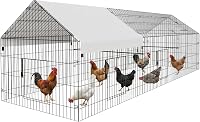
The VAGGER run is 15 x 10 ft, so its width is 10 ft. That gives birds a broad short side and still leaves a good 15 ft length.
The galvanized frame has a peaked roof and hexagonal wire mesh, plus a full-height door with a latch.
VAGGER says the 15 x 10 x 6.5 ft size suits 20 to 30 chickens, though capacity varies by breed and setup. The roof cover is waterproof and UV resistant.
Check the size against your own square footage before you rely on that count.
Does a long run change how you manage the flock?
A long run needs more feeder and water points, plus regular ground checks. Birds at opposite ends won't walk back to a single feeder, so set feed and water within reach of each section.
Hang the feeder at one end and water at the other, then swap them now and then so both areas share the wear. A long run also needs more shade, since part of it will be in sun most of the day.
The covered end helps, but a shade cloth or a bush gives birds a second option.
Walk the run weekly. Look for wet spots, bare patches, and digging at the base.
A long fence line gives more places for a fox to try, so bury the wire or add a skirt along the whole perimeter.
Which run length fits your flock?
Pick a run that is long enough for your flock's daily use, not just the minimum. For 4 to 6 birds, a run around 10 ft long is a good start.
For 12 birds, go to about 20 ft.
For all-day flocks or 20 birds, stretch to 30 ft or more.
The CHIKENCOOP 9.8 ft run suits a small flock in a backyard. The VEVOR 19.6 ft run fits a mid-size flock that needs more walking room.
The VAGGER 15 x 10 ft run gives a wider layout for 20 to 30 birds.
If you build your own, keep the short side at 6 ft and make the long side as long as your space allows. That shape gives chickens what they use most: room to walk.
Pair the run with a coop that suits your climate, and see whether a chicken coop should be insulated before winter arrives.
Frequently asked questions
Does a longer chicken run really make chickens happier?
Length gives chickens more room to walk from one end to the other and spread out while scratching. A long, narrow run at the right square footage works better than a short, wide one, because birds move in straight lines and peck along the edges.
Can a chicken run be too long and narrow?
A run can be too narrow if a bird cannot pass another bird comfortably or reach both sides. Keep the short side at least 5 to 6 feet wide so two birds can walk side by side and you can reach in without climbing.
How do I work out the length for my flock?
Multiply your flock size by 10 for a no-free-range run, or by 20 if they stay in all day. Divide that number by the width you can fit on your land.
Divide that area by the width of your run to get the minimum length, and adding a few feet costs little.
Does a longer run mean more predators?
Length by itself does not invite predators, but more open run perimeter gives more places to dig under. Bury the wire or add a skirt at the base, and lock the coop and run at night so length stays a benefit.
Can I split a long run into two sections?
Yes. A long run is easier to split with a gate, so you can rest one section while the grass recovers.
Rotate the flock between halves, keep water in both, and let each side regrow before moving the birds back.